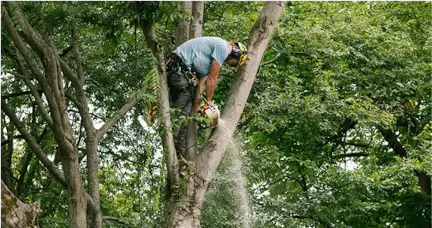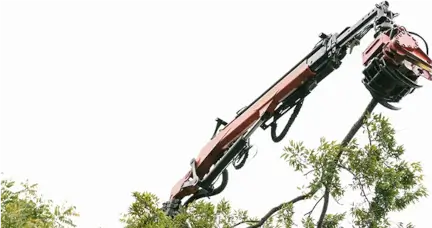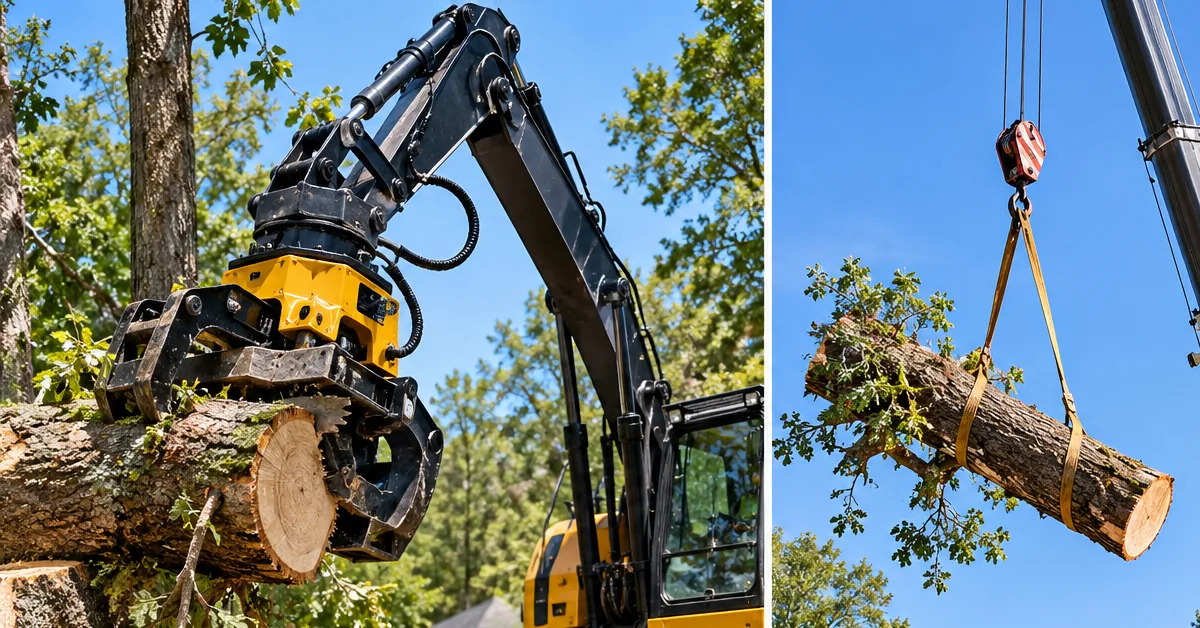
Not every tree comes down the same way. If you’ve got a big hardwood leaning over your garage or a dead ash standing in an open backyard, the equipment your crew uses matters just as much as the crew itself. In Nashville, the two most common methods for removing large trees are GrappleSaw removal and crane-assisted removal. They’re both controlled approaches that take a tree apart in sections, but the equipment, cost, and best-use cases are different.
The short version: a GrappleSaw works great when the machine can reach the tree and there’s room to operate. A crane is the better call when the tree sits over a structure, the lot is tight, or there’s no clear ground path for heavy equipment. Here’s a closer look at how each one works and what drives the decision.
How a GrappleSaw Works
A GrappleSaw is a piece of heavy equipment that combines a hydraulic grapple with a cutting saw on the end of a boom. The operator can cut a section of the tree, grab it, and set it down in a controlled motion. That means fewer cuts made by a climber up in the canopy and less dropping of heavy wood. Each piece gets placed where the crew wants it instead of falling to the ground.
This is a big deal for property protection. When the operator has control of each section from cut to ground, there’s less risk of tearing up lawns, crushing garden beds, or dinging a fence. It also tends to speed things up. The machine handles a lot of the heavy lifting that would otherwise require manual rigging.
The catch is access. The GrappleSaw needs a clear route to the tree, and the property has to have enough room for the machine to swing and maneuver. Properties with wide driveways, accessible side yards, and open lots are ideal. Narrow gates, retaining walls, steep grades, and soft or saturated ground can all create problems.
How Crane-Assisted Removal Works
Crane-assisted tree removal uses a crane to lift sections of a tree up and away from the work area. A climber or ground-based operator makes the cut while the crane holds the section under tension. Once the piece is free, the crane picks it up and swings it to a designated drop zone, usually the street, driveway, or an open part of the yard.
The real strength of crane work is overhead clearance. When a tree is growing directly over a house, garage, or pool enclosure, you can’t safely lower pieces through the structure. A crane lifts them straight up and away. That’s something no ground-based machine can replicate.
Crane removal also solves access problems in a different way. The crane can sit on a street or driveway and reach over fences, buildings, and other obstacles with its boom. So even if the tree is in a backyard that no tracked machine can get to, the crane can still reach it from the front of the property.
Ground Access Is the First Thing Your Crew Will Look At
Before anyone talks about pricing or scheduling, the first question is whether a GrappleSaw can physically get to the tree. That means evaluating the path from the street to the tree and the space around the tree itself.
A lot of Nashville’s older neighborhoods have properties that weren’t built with heavy equipment in mind. Homes in Sylvan Park, East Nashville, Germantown, and parts of the Nations often have narrow side yards, short driveways, and mature trees planted close to the house. In those situations, a GrappleSaw might not be able to get close enough to do the job safely.
A crane can often work around those limitations. It sets up on a firm surface, deploys outriggers for stability, and reaches the tree with its boom. That’s why an on-site visit matters so much. Two trees that look similar on paper can require completely different equipment once you see the property layout. According to OSHA’s enforcement guidance for tree care operations, proper equipment selection based on site conditions is a key part of safe tree work.
Where the Tree Sits Relative to Structures
After access, the next big factor is position. A tree standing out in the middle of an open yard is a straightforward GrappleSaw job nine times out of ten. The crew can cut sections and place them on the ground without worrying about a roof, a fence, or a power line.
Trees close to structures are a different story. If the canopy hangs over the house, or large limbs extend across a garage or patio cover, a crane gives the crew a way to lift those sections clear of the building. Trying to lower heavy wood through a tight gap between a tree and a roofline with only rigging and ropes is riskier and slower. The crane takes that variable off the table.
Power lines add another layer. Nashville Electric Service lines run through a lot of residential properties, and any tree work near energized lines requires careful planning. A crane can provide a more controlled lift path that keeps heavy sections well away from the wires. That’s something a GrappleSaw can’t always do if its swing radius overlaps with the lines.
Cost and Timing: What to Expect
Crane work generally costs more. You’re paying for the crane itself, transport and setup, an operator, rigging coordination, and often more planning time before the crew shows up. All of that adds to the bill compared to a GrappleSaw job where the machine drives in and gets to work.
GrappleSaw jobs tend to move faster when the site cooperates. The machine handles cutting and material movement in a single operation, which reduces the manual labor involved. On a property with good access and trees in open positions, a GrappleSaw crew can be remarkably efficient.
But here’s the thing: you shouldn’t pick a method based on price alone. If the tree is hanging over your house and a GrappleSaw can’t safely handle it, the lower estimate doesn’t matter. The right comparison is between methods that can both do the job safely. A professional tree risk assessment will tell you which methods are actually on the table for your specific tree.
Protecting Your Property During Removal
Both methods can protect your property when they’re used correctly, but they do it in different ways.
A GrappleSaw excels at protecting the ground. Because the operator grabs each section and sets it down, there’s very little impact on the lawn, garden beds, or landscaping around the tree. If you’ve spent money on your yard and want it to look the same after the tree is gone, a GrappleSaw is hard to beat.
A crane excels at protecting what’s underneath the tree. If a large red oak is growing through the canopy right above your roof, the crane lifts those sections straight up and away. No piece of wood passes over the house. That’s the kind of control you need when the stakes are highest.
After the tree is down, most properties also need the stump addressed. Leaving a stump in place can attract pests, create tripping hazards, and get in the way of future landscaping or new tree planting. Stump grinding is usually a separate step that follows the removal regardless of which method was used.
Can Both Methods Be Used on the Same Property?
Absolutely. If you have several trees coming down on the same property, the crew might use a GrappleSaw for the ones in the open yard and bring in a crane for the one hanging over the house. That’s actually a smart approach because it matches the right tool to each tree instead of forcing one method onto every situation.
A company that keeps both capabilities in-house has more flexibility to do this. If the only option is a GrappleSaw, every tree gets approached with a GrappleSaw whether that’s the best fit or not. Having a crane available means the crew can make the safest call for each individual tree.
Why an In-Person Assessment Matters
You can’t make this decision over the phone. A photo helps, but it doesn’t show the full picture. Ground conditions, overhead clearances, distances between the tree and nearby structures, gate widths, slope, soil firmness, utility line positions — all of that factors into the equipment choice.
The ISA Tree Risk Assessment Qualification (TRAQ) trains arborists to evaluate trees systematically based on site conditions, structural defects, and failure potential. That kind of structured assessment is what separates a real equipment recommendation from a guess. Any company that gives you a firm quote without visiting the property is skipping steps you’ll pay for later.
A qualified arborist will walk the property, look at the tree from multiple angles, check the ground access, note the proximity to structures and lines, and then tell you which method makes sense. Sometimes the answer is obvious. Sometimes it takes some thought. Either way, the on-site visit is where the real decision gets made.
Frequently Asked Questions
Can a GrappleSaw remove a tree that’s leaning toward my house?
It depends on how severe the lean is and how much clearance exists between the tree and the house. If the crew can safely cut sections and swing them away from the structure, a GrappleSaw may work fine. But a heavy lean directly toward the house usually makes crane-assisted removal the safer call because the crane can hold each section under tension and lift it away cleanly.
Is crane removal always more expensive?
Generally, yes. Crane work involves additional equipment, transport, setup, and coordination that add to the cost. But the price difference varies a lot depending on the job. A straightforward crane lift on an easy-to-access street might not cost much more than a complicated GrappleSaw job in a tight backyard. The only honest comparison is between methods that can both handle the tree safely.
Can GrappleSaw equipment fit through a fenced backyard?
That depends entirely on the gate width and the path to the tree. The crew has to evaluate the entire route, not just the gate opening. Low-clearance areas, retaining walls, underground utilities, and tight turns can all prevent access even if the gate itself is wide enough. An on-site assessment is the only way to know for sure.
Will a crane damage my driveway?
Cranes use outriggers to spread their weight across a larger area, and experienced operators evaluate the surface before setting up. Some driveways or surfaces may need additional protection, especially with heavier cranes. A good crew will take precautions and discuss any concerns with you before they start. Damage is uncommon when the setup is planned properly.
Does the type of tree affect which method gets used?
Species plays a role in planning, but size and position usually drive the decision more than species alone. A dense hardwood like a white oak weighs significantly more per section than a soft maple, which affects rigging and lift calculations. But the equipment choice still comes down to access, proximity to structures, and what the site allows.
What if I need emergency tree removal?
Storm damage and sudden failures don’t wait for a convenient time. In an emergency, the crew assesses the situation on arrival and uses whatever method is safest given the conditions. If a tree has fallen on a house, a crane may be the only way to remove it without causing more damage. If it’s down in an open area, a GrappleSaw can clear it quickly. Either way, the priority is safety first, then protecting the property.
How do I know which method my tree actually needs?
Schedule an in-person assessment. A qualified arborist will evaluate the tree, the access, the surrounding structures, and the site conditions, then recommend the right approach. Phone estimates and photo-only quotes skip too many variables. The on-site visit is where you get an honest answer.
Can both methods be used on the same job?
Yes, and it’s more common than people think. A property with multiple trees might benefit from GrappleSaw removal on trees in the open yard and crane assistance for a tree positioned over the house. Using both methods on the same job often makes the entire project safer and more efficient. It also helps keep costs reasonable because you’re not paying for crane work where a GrappleSaw would do just fine.