Key Takeaways
- GrappleSaw suits properties with clear equipment access and trees positioned away from structures.
- Crane-assisted removal is reserved for trees over structures, in tight lots, or near power lines.
- Ground access and the tree’s position relative to structures are the two biggest deciding factors.
- Crane work generally costs more due to added equipment mobilization and rigging coordination time.
- An in-person assessment, not a phone estimate, is the most reliable way to determine the right method.
Choosing between a GrappleSaw and a crane depends on the tree, the property, ground access, tree position, and nearby structures. A GrappleSaw is usually a best fit when the machine has clear access to the tree and enough room to operate. Crane-assisted tree removal is often better for trees over homes, tight urban lots, and other difficult locations. Both methods remove trees in controlled sections. However, they use different equipment and techniques.
Understanding how each method works can help property owners set realistic expectations for cost, timing, safety, and property protection.
What Does a GrappleSaw Actually Do?
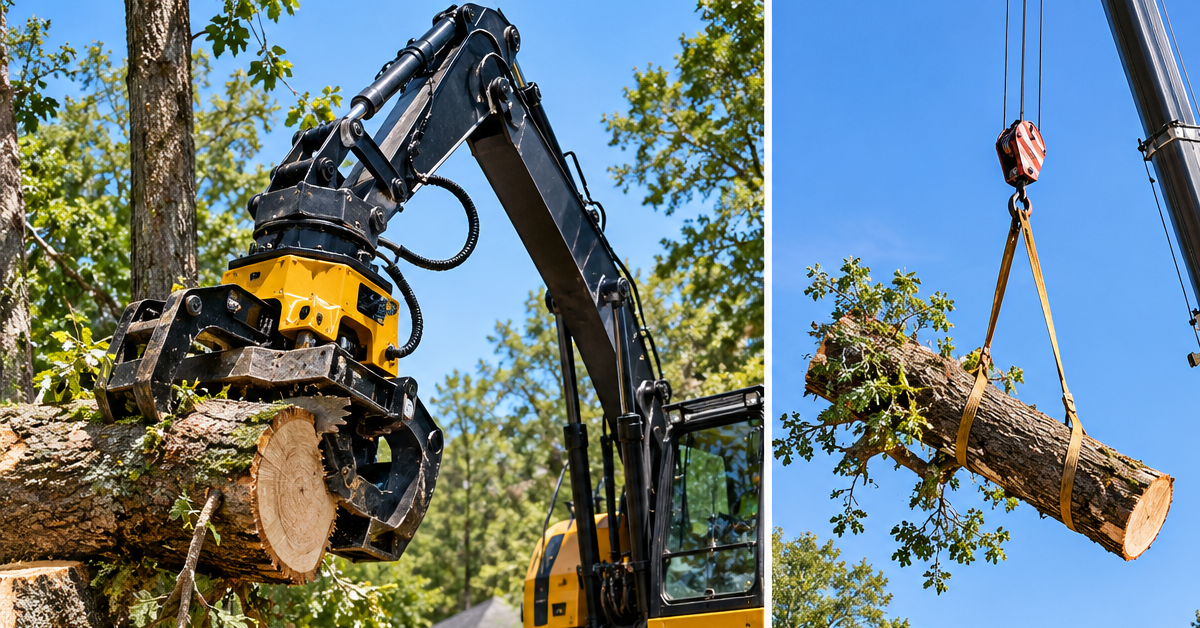
A GrappleSaw combines a cutting saw with a hydraulic grapple. The operator can cut a section, grab it, and move it to a safe location. This reduces the need for a climber to make every cut from inside the tree canopy. The equipment can save time and reduce the amount of work performed at height. It also gives the operator control over each section as the crew removes it. Instead of dropping sections, the operator can lower them in a controlled motion.
This controlled approach can help protect lawns, landscaping, garden beds, and other features around the work area. However, the machine needs a clear route to the tree. The property must also have enough space for the equipment to maneuver safely.
Properties with wide driveways, accessible gates, and open yards are often good candidates for GrappleSaw removal. Tight gates, narrow side yards, retaining walls, and soft ground can make access more difficult.
What Does Crane-Assisted Removal Actually Do?
Crane-assisted tree removal uses a crane to lift tree sections away from the work area. The crane can handle large sections and move them over obstacles. This gives crews more options when a tree stands close to a home, garage, fence, or other structure.
A climber or ground-based cutter typically makes the cut while the crane holds the section under tension. Once the section is free, the crane lifts it away and places it in a designated drop zone. That zone may be a driveway, street, or open part of the yard.
Crane removal works especially well when a tree sits directly over a structure. It can also help when buildings or other obstacles leave little room for a GrappleSaw. The crane can lift sections away before they have a chance to affect the structure below.
Ground Access: The First Deciding Factor
Ground access is one of the first things a dedicated tree service firm in Nashville, Tennessee evaluates. A GrappleSaw needs a clear path to reach the tree. The route must also provide enough room for the machine to operate.
Narrow gates, tight side yards, retaining walls, and soft ground can all create access problems. Some older Nashville neighborhoods have properties with limited space between homes. These conditions can make it difficult or impossible to bring a GrappleSaw into the backyard.
A crane can sometimes solve these access challenges. The crane may be able to sit on a street or driveway while its boom reaches over obstacles. This allows crews to work on trees that ground equipment cannot reach.
That is why an on-site assessment matters. Two trees of similar size can require completely different equipment based on the property layout. A phone description rarely provides enough information to make that decision with confidence.
Position Relative to Structures
The tree’s position is another major factor. A tree standing in an open yard is often a straightforward GrappleSaw job. Crews can cut the tree into sections and move them into an open area without passing them near valuable structures.
Trees close to homes, garages, fences, and other structures require more planning. A GrappleSaw may still work if the crew has a clear path for moving each section. However, a crane may be safer if the tree’s size or position creates a risk of contact with a structure.
A crane can lift sections away from the structure rather than lowering them through a narrow space. This can provide greater control on high-risk removals.
Power lines are another important consideration. Nearby lines can limit equipment movement and create additional hazards. In some situations, crane assistance can give the crew a more controlled lift path and make it easier to keep sections away from the lines.
Cost and Timeline Differences
Crane-assisted tree removal generally costs more than GrappleSaw work. The additional cost comes from crane mobilization, specialized equipment, operator coordination, and rigging. Complex removals may also require more setup and planning.
GrappleSaw work can often move faster when the property provides good access. The machine can handle much of the cutting and material movement. This can reduce the amount of manual rigging and coordination required.
However, homeowners should not choose a method based on price alone. A lower GrappleSaw estimate does not matter if the equipment cannot safely handle the tree. If the tree’s position requires a crane, crane-assisted removal is the more appropriate option. The most useful cost comparison is between methods that are both safe and practical for the specific tree.
Property Protection Considerations
Both methods can help reduce property damage when crews use them correctly. However, each method offers different advantages. A GrappleSaw can help protect lawns and landscaping because the operator can grab and lower each section. This reduces the need to drop heavy sections onto the ground.
Crane-assisted removal offers a major advantage when a structure sits beneath or close to the tree. The crane can lift sections away from the home, garage, or other obstacles. This reduces the risk of a large section striking the structure.
Crane work still requires careful planning. The crane needs a suitable staging area, and its outriggers require enough space. Depending on the property, the crew may also need to take precautions to protect the driveway or other surfaces.
Chop Nashville Tree Care handles complex tree removals by keeping both GrappleSaw technology and full crane capabilities in-house. Our ISA-Certified Arborists assess your property layout to choose the safest, most efficient equipment for the job. Whether dealing with open yards or tight spots over rooflines, Chop Nashville Tree Care uses precision rigging to protect surrounding structures. Serving Davidson and Williamson Counties, Chop Nashville provides 24/7 emergency response, thorough cleanup, and transparent pricing.
Frequently Asked Questions About GrappleSaw and Crane Removal in Nashville, Tennessee
Can a GrappleSaw remove a tree that is leaning toward my house?
It depends on the tree’s lean and the available clearance. If crews can safely cut and move each section away from the house, a GrappleSaw may work. A significant lean toward a structure may make crane assistance the safer choice.
Is crane-assisted removal always more expensive than GrappleSaw work?
Generally, yes. Crane removal requires additional equipment and coordination. It may also involve more rigging and setup time. However, the right comparison is between methods that can both safely handle the specific tree.
Does my Nashville property need a survey before crane work?
An on-site assessment is typically needed before crane work. The crew needs to determine where the crane can safely sit and whether it has a clear lift path. Nearby homes, power lines, fences, driveways, and other obstacles can affect crane placement.
Can GrappleSaw equipment access a fenced backyard?
It depends on the gate width and access path. The crew must consider the entire route from the equipment entry point to the tree. Narrow gates, low-clearance areas, retaining walls, and other obstacles may prevent GrappleSaw access.
Will crane-assisted removal damage my driveway or street?
Cranes use outriggers to distribute their weight. Experienced operators also consider the surface beneath the equipment before setting up. Some driveways or other surfaces may require additional protection, especially when the equipment is particularly heavy.
How do I know which method my tree needs?
An in-person assessment is the most reliable way to determine the right method. A professional can evaluate the tree, ground access, nearby structures, power lines, and other site conditions. These details are difficult to assess accurately from a phone description alone.
Does tree species affect the choice between GrappleSaw and crane?
Tree species can affect removal planning, but size and position usually play a larger role. Wood density and overall weight can influence how crews plan the job. The equipment choice ultimately depends on the specific tree and property.
Can both methods be used on the same job?
Yes. A property with several trees may benefit from both methods. Crews could use a GrappleSaw for trees in an open part of the yard and a crane for trees positioned over structures. Using different equipment can make the entire project safer and more efficient.
Summary Checklist: GrappleSaw vs. Crane
| Factor | Favors GrappleSaw | Favors Crane |
| Ground access | Clear path for equipment | Tight, narrow, or obstructed access |
| Tree position | Open yard, away from structures | Over or near structures |
| Power lines | Not a major factor | Lines require careful lift planning |
| Cost | Generally lower | Generally higher |
| Timeline | Often faster on suitable jobs | May take longer due to rigging |
| Landscape impact | Controlled lowering protects landscaping | Keeps sections away from structures |
Final Advice
Choosing between a GrappleSaw and a crane is not about finding one method that is always better. The right choice depends on the tree, the property, and the risks involved.
Ground access is a major consideration. So is the tree’s position relative to homes, garages, fences, and power lines. Property owners should expect an in-person assessment before the crew recommends a specific method.
Chop Nashville Tree Care keeps a GrappleSaw crane in-house and also offers full crane capability. This gives our team flexibility when planning tree removal. Our crew can choose equipment based on what the tree and property actually require rather than simply using whatever equipment happens to be available.